 Live
Live
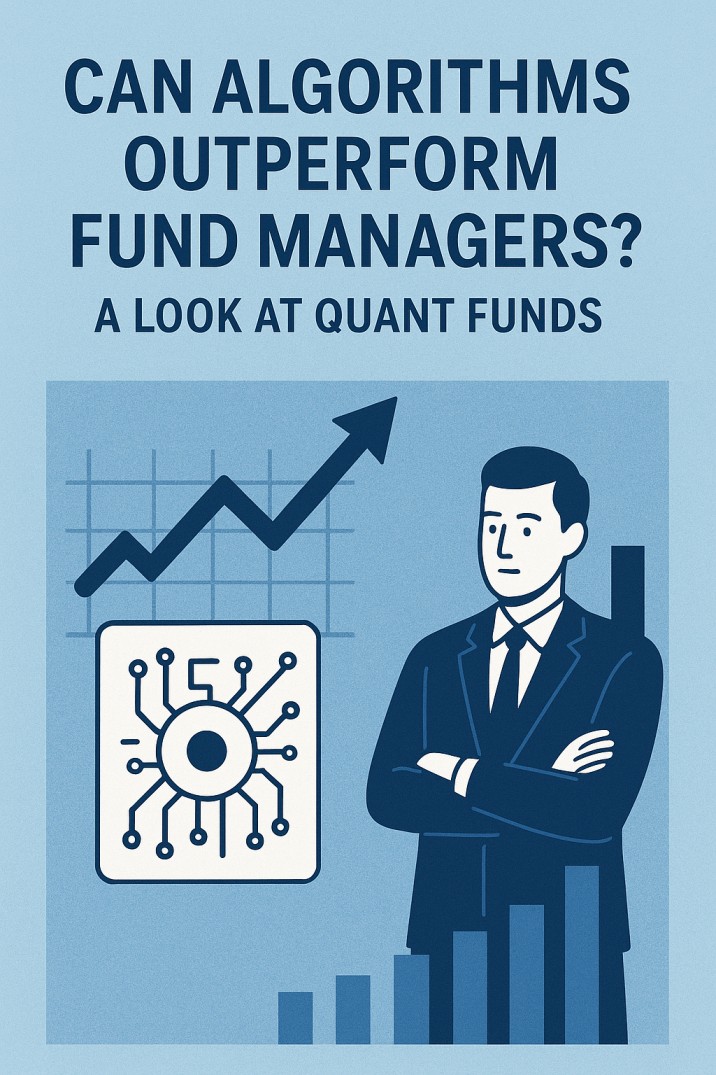
As markets become more unpredictable and human judgment gets cloudier by the day, a new debate is shaking up the world of mutual funds—can cold, calculated algorithms really outperform seasoned fund managers?
Picture this:
A system that never panics during a crash, never gets greedy during a rally, and never falls for hype. Instead, it scans thousands of data points, detects hidden patterns, and makes decisions in milliseconds—something no human can match.
That’s the power behind quant-based mutual funds. And in this article, we explore whether these algorithm-driven strategies can truly rival the instinct, experience, and emotion-led decisions of human fund managers—and what this shift could mean for the future of investing.
Understanding Quant Mutual Funds
Quant Mutual Funds are investment schemes where algorithms—not human fund managers—drive the decisions. These models sift through massive datasets such as stock prices, financial statements, and economic trends to determine what to buy or sell.
The idea is straightforward:
Remove emotions, follow the rules, and let objective data guide every move.
The result? A disciplined, statistics-based investing style that’s becoming increasingly popular in India—especially among investors seeking consistency over intuition.
Key Features of Quant Mutual Funds
To understand their edge, here’s what sets quant funds apart:
Algorithm-Driven Decisions
Computer models—not human instinct—select the stocks. This keeps the process disciplined and emotion-free.
Data-Based Investing
Algorithms analyse huge datasets to spot patterns that human eyes often miss.
Objective and Transparent
Since decisions follow predefined rules, investors always know the logic behind the strategy.
Diversification Built In
Models spread investments across sectors and stocks to reduce concentration risk.
Risk Management at the Core
Algorithms include safeguards to limit exposure to volatile or unpredictable stocks.
No Human Bias
Fear, greed, hesitation—these behavioural pitfalls vanish because models stick strictly to data.
Cost Efficiency
Automation reduces operational effort, often lowering costs.
Backtested, Not Blind Guesswork
Strategies are tested on decades of historical data before they go live.
Constant Innovation
Models can combine advanced approaches such as momentum, value, or factor investing with precision.
Types of Quant Mutual Funds
As quant investing evolves, investors can choose from different styles—each tailored to unique goals.
Active Quant Funds
These funds use algorithms that actively pick stocks to outperform a benchmark. The process stays fully rule-based, with no emotional input.
Passive Quant Funds
These mirror indices like the Nifty 50 or Sensex. They focus on replicating—not beating—the market, making them efficient choices for long-term investors.
Single-Factor Quant Funds
Here, the algorithm focuses on one factor (such as value or momentum). Think of it like following a single, clear philosophy.
Multi-Factor Quant Funds
These combine multiple factors—value, momentum, quality, volatility—to create a more stable, balanced portfolio across market conditions.
How Quant Mutual Funds Work
Now, let’s connect the dots and see how all of this happens in practice.
1. Input System
The process starts by collecting thousands of data points—from stock prices to interest rate trends. This helps filter out companies that don’t fit the fund’s criteria (like overly volatile stocks or financially weak firms).
2. Forecasting Engine
After filtering, the algorithm predicts how the shortlisted stocks may perform.
Example: It may estimate how a banking stock performs in high-interest-rate phases or how a tech stock behaves when the rupee weakens.
3. Portfolio Construction
Finally, the algorithm builds the actual portfolio. Using optimisation techniques, it assigns the right weight to each stock to balance risks and returns.
Some funds use minimal human oversight, while others are fully automated.
SEBI Rules for Quant Mutual Funds
As quant investing grows, SEBI ensures innovation doesn’t come at the cost of investor safety.
Algorithm Approval
Every algorithm must be approved and registered before use, reducing technical or behavioural risks.
Unique Identification for Algorithms
Each one receives a unique ID, making it easier to trace errors or irregular trades.
White Box vs Black Box Systems
White Box models are fully transparent.
Black Box models—where details are proprietary—must register as research analysts and follow strict reporting norms.
Broker Controls and API Safety
Brokers monitor algorithmic trades, use kill switches, and allow access only through secure APIs.
Strategy Visibility and Risk Management
Quant funds must clearly disclose their strategy, maintain diversification, and provide regular updates.
Balancing Innovation with Protection
SEBI supports innovation but ensures systems operate responsibly, safeguarding both investors and market stability.
Who Should Consider Quant Funds?
Quant funds suit investors who prefer logic over intuition.
They work best for:
- Long-term investors who want systematic, consistent growth
- People who appreciate data-driven decision-making
- Busy professionals who can’t track markets daily
- Those comfortable with moderate to high risk
- Investors who like transparency and rule-based investing
If you prefer discipline, structure, and minimal emotional interference—quant funds may fit you well.
Pros and Cons of Quant Mutual Funds
Let’s connect everything discussed so far with a balanced view.
Pros
Quant funds offer objective, data-driven decisions that eliminate emotional bias. Algorithms maintain discipline even during turbulent markets and can react quickly to sudden changes. Their rule-based nature also provides consistency and transparency.
Cons
Performance depends heavily on the quality of the algorithm. When markets behave in ways not captured in historical data (like unexpected geopolitical events), models may struggle. Some strategies may also involve higher costs and limited scope for human judgment.
So… Can Algorithms Outperform Fund Managers?
This is the heart of our title—and the real debate.
The truth is: sometimes they do, sometimes they don’t.
Algorithms excel in:
- Avoiding emotional bias
- Processing massive datasets quickly
- Maintaining discipline
- Detecting patterns invisible to humans
Human fund managers excel in:
- Interpreting context
- Understanding market sentiment
- Reacting to unprecedented events
- Applying intuition built over decades
Example: Algorithms may not “understand” why a geopolitical conflict suddenly changes market mood. A seasoned manager may.
But managers may get influenced by media noise or emotions during a crash, whereas algorithms won’t.
In reality, the future is likely a hybrid approach—where algorithms handle number-crunching and humans guide high-level judgement.
Bottomline
Quant funds bring a modern, technology-driven approach to investing—offering discipline, transparency, and the power of data over emotions. With SEBI’s strong regulatory framework supporting their growth, quant funds are emerging as a reliable option for investors who believe in systematic, algorithm-led wealth creation.
As these models evolve, they could become a powerful addition to portfolios seeking long-term consistency, innovation, and stability. Algorithms may not replace human insight entirely—but together, they might redefine what smart investing looks like in the years ahead.
Unicorn Signals leverages advanced AI technology to provide you with powerful market predictions and actionable stock scans. Download the app today and 10x your trading & investing journey!