 Live
Live
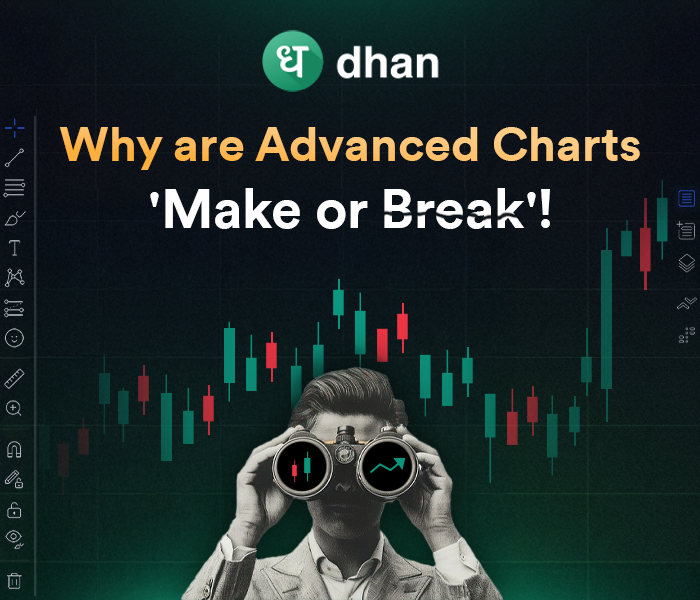
Nowadays, the market is overly crowded by traders, investors and institutions. Due to this, participation has increased, liquidity is changing rapidly, and prices react sharply to any news. In such a noisy environment, traders have to see through a noisy wall to get clarity.
To see through that wall, advanced charts are well equipped with many tools and indicators which filter out the noise and let the trader see a better picture of the market. Basic charts allow you to see the price movements with high, low, open and close values. But advanced charts allow you to see structure, participation, and risk more clearly with a few clicks. A trader using the basic chart will not be able to catch the speed of a trader who is using the advanced chart. Hence, for traders, learning advanced charts is like ‘make or break’.
What Are Advanced Charts?
A basic chart shows price over time, usually with a candlestick or line. However, an advanced chart on a platform like TradingView includes additional information that helps interpret what that price movement actually means. It includes multiple timeframes, volume analysis, dynamic support and resistance, momentum behaviour, and market structure.
The purpose of the advanced charts is to give additional information in an organised way and within a fraction of a second. Traders can use this data to make data-based decisions.
Why Basic Charts Fail in Live Trading Conditions
When markets are noisy, basic charts struggle to provide accurate data. Small fluctuations can appear like a significant move even though they do not have any relevance.
Basic charts do not provide participation data. Sometimes, prices can move without large volume, can stall near the important zones or reverse suddenly. On a basic chart, these changes are hard to predict. Because of this, traders make late entries and exit emotionally, which leads to losses.
For traders, it is very difficult to understand the support, resistance, trend direction, and momentum through a basic chart. Traders need to rely on their instincts and not on market data. Which creates inconsistent results.
For example, if a stock is trading at ₹500 and breaks above ₹505 on a 5-minute basic chart. A trader enters the trade expecting a breakout. But if volume at the breakout candle is 30% lower than the session average, which is not visible clearly on a basic chart. The price might move briefly to ₹508 and then reverse sharply to ₹495 as selling pressure emerges near a higher-timeframe resistance.
An advanced chart highlights weak volume participation and nearby resistance, helping the trader avoid a poor entry or manage risk better.
Core Components of Advanced Charts
Advanced charts combine multiple elements that help traders understand where the price is and why it is moving. These components form the foundation of structured chart analysis.
Multi-Timeframe Structure
Advanced charts support multi-timeframe structure. Traders always compare the long-term trend on two or more key timeframes.
For example, a breakout on a five-minute chart may look attractive. But if that breakout is pushing directly into resistance on a daily chart, the chances of a long trend are limited. In such cases, there are chances of sudden reversal, which may lead to losses.
Volume and Market Participation
Price movements without volume cannot be trusted. Volume analysis is one of the most important aspects of trading. Volume gives a clear idea of where the market is leaning. Advanced charts use volume bars, volume profiles, or session-based tools to show volumes.
A strong trend usually shows increased volume during expansion. When the price moves with little volume, it creates a false signal and is not able to sustain the move.
Dynamic Support and Resistance
Basic charts show us the traditional horizontal support and resistance levels. They are useful, but in a dynamic market like today, traders need to analyse multiple levels with different tools like moving averages, VWAP, or Bollinger Bands, etc.
These dynamic levels are reaction points. There are chances of price slowdown, reversal or breakout. Entry and exits can be planned based on these levels.
Momentum and Trend Behaviour
Almost all advanced charts include momentum and trend indicators. Indicators like EMA structure and RSI behaviour help traders to confirm whether price movement is supported or not.
For example, an RSI above 50 during pullbacks indicates trend strength, even if the price consolidates. Similarly, price respecting short-term moving averages suggests that buyers or sellers remain in control.
How Advanced Charts Improve Trading Decisions
Advanced charts improve decisions in several ways.
- Entry quality – Traders will get quick information about price structure, volume and trend alignment, which helps traders for timely entry.
- Exit clarity – Advanced charts provide live data through which traders can analyse the volume and momentum. If they see the volume is reducing and the trend momentum is weakening, then they can make an exit and stop the possible loss.
- Risk placement – Advanced charts provide the key price zone for support and resistance. This gives a clear structure of the market, allowing traders to add stop losses and hedging tactics. It improves risk-reward consistency.
- Emotional Trading – As the advanced charts give all the information at your fingertips, there is less chance that the trader will make emotional decisions.
Where Advanced Charts Add the Edge
Advanced charts greatly enhance performance. Poor execution causes losses for a lot of traders. Even effective tactics can backfire if they are not implemented correctly.
Execution becomes more accurate when traders are aware of liquidity and momentum status. Exits are less hurried, and entrances are better timed. Although there may be fewer trades as a result, performance is significantly improved.
Common Mistakes Traders Make with Advanced Charts
Some common mistakes which traders usually tend to make are listed below. Traders have to understand these mistakes and try to avoid them.
- Many traders use excessive indicators. Adding more and more indicators gives different signals and can lead to confusion. Advanced charts must be structured and not crowded. Use of 3-4 indicators is more than enough.
- Beginners commonly trade by assuming every signal is a trade opportunity. Indicators must be used for confirmation, and traders must consider the broader market context before making an entry.
- News and events impact the market sharply. Traders must not underestimate these factors. Advanced charts reduce risk, but they do not eliminate it.
Who Benefits Most from Advanced Charts?
Almost everyone is benefiting from using advanced charts. Intraday traders time the entry and exit of any trade using advanced charts. Minor timing errors can have large consequences. Accessing the advanced charts through a trading app can help traders across styles analyse markets more efficiently.
Swing traders manage their positions by looking at various indications and market data provided by the advanced charts over several days. Option traders get the information about volatility, structure, risk zones, and volume-related data.
Active investors use the advanced charts to avoid poor entries by checking the current trend with the 200 EMA and other tools available.
Advanced Charts as a Skill, Not a Shortcut
Advanced charts must be viewed as an upgrade to your skills. It also requires discipline, patience, risk management and emotional control as before. With these qualities, they make market behaviour easier to interpret.
Many traders always search for new strategies and ignore the market structure. Any strategy is better if applied correctly and executed in a timely manner. It will give the same results as the new strategy. But instead of learning a number of new strategies, if you invest that time in understanding the market, it will generate better results.
Most traders start with basic charts. Understanding the basic chart will help immensely when they use advanced charts. It is like learning to ride a bicycle first and then gradually shifting to a motorcycle. It builds confidence and can be easier to understand.
As the confidence level and experience increase, traders begin adding tools one by one, testing how each improves understanding. This gradual transition is healthier than copying complex chart setups from others.
Final Perspective
Modern markets are complex and very volatile. Making successful trades using basic charts is almost impossible. Traders need to upgrade their skills by learning advanced charts. Learning advanced charts is no longer optional; it is a necessity if a trader wants to survive in the modern market.
At the same time, traders must understand that the advanced charts are not a shortcut to success, but they can be a stepping stone towards success. Just like earlier, discipline, patience, risk management, and emotional control are irreplaceable skills.
Charts do not trade. Traders do. But the right charts can make that job clearer, calmer, and far more consistent.