 Live
Live
“Mutual funds are subject to market risks” is a line every investor has heard. But here’s the real issue—it tells you that risk exists, not how much risk you are actually taking.
For most investors, the decision isn’t about avoiding risk altogether. It’s about knowing how much uncertainty they’re comfortable with and whether a fund matches that comfort level. This is exactly where the Mutual Fund Riskometer earns its place.
Think of it as a quick reality check. A simple visual tool that cuts through lengthy documents and clearly shows whether a mutual fund is playing safe or taking aggressive bets. In this blog, we break down how the Riskometer works, why it matters, and how you can use it to make smarter, more confident investment decisions.
What Is the Mutual Fund Riskometer?
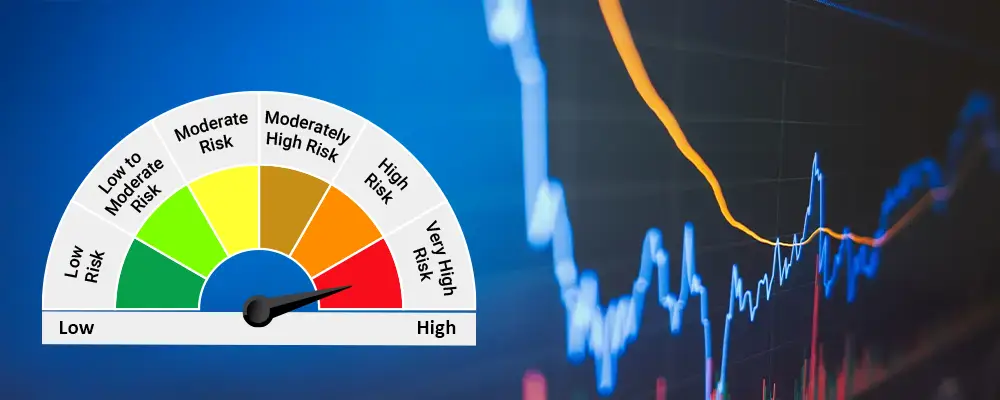
The Mutual Fund Riskometer is a visual indicator, designed like a speedometer, that shows the risk level of a mutual fund scheme. Instead of decoding technical data, investors can instantly see whether a fund falls on the lower, middle, or higher end of the risk spectrum.
This matters because not all mutual funds behave the same way. Some invest mostly in government bonds and aim for stability. Others invest heavily in equities, where prices can swing sharply in the short term. The Riskometer captures these differences at a glance.
In India, SEBI first introduced the Riskometer in March 2013 using a simple three-colour system. However, that approach proved too broad and didn’t fully reflect the wide range of risk profiles across funds.
To address this, SEBI rolled out the current Riskometer framework on 1st July, 2015, expanding it into more defined categories. Today, the Riskometer uses six distinct risk levels, and fund houses are required to update it every month. This ensures investors always see a current and realistic picture of the risk they are taking.
Over time, the Riskometer has become more than just a label. It helps set expectations clearly—higher potential returns usually come with higher volatility, and the Riskometer makes that trade-off visible before you invest.
Understanding the Six Risk Levels on the Riskometer
Now that we know what the Riskometer is, the next logical step is understanding what each level actually means for an investor.
SEBI classifies all mutual fund schemes into six standard risk categories, based on the assets they invest in and the volatility investors may experience.
Low Risk
Low-risk funds focus on capital protection. They usually invest in instruments such as treasury bills and government securities. Returns are relatively stable, but growth is limited. These funds are often chosen by conservative investors or those parking money for very short periods.
Example: An investor planning to use funds within a year may prefer this category to avoid market swings.
Low to Moderate Risk
These funds take a small step up the risk ladder. They mainly invest in high-quality debt instruments, with limited exposure to slightly higher-yield assets. Volatility remains controlled, making them suitable for short- to medium-term goals.
Moderate Risk
Moderate-risk funds aim for a balance between stability and growth. They may invest in a mix of debt and equity or in debt instruments with average market sensitivity. Some ups and downs are expected, but the risk remains manageable over time.
Moderately High Risk
Funds in this category have greater exposure to equities or riskier debt instruments. Short-term fluctuations can be more noticeable, but the potential for higher returns also increases. These schemes suit investors with a medium- to long-term horizon who can stay invested during market volatility.
High Risk
High-risk funds are largely equity-oriented and tend to react sharply to market movements. Returns can vary significantly in the short term. Investors choosing this category usually have a longer investment horizon and a higher tolerance for volatility.
Very High Risk
This is the most aggressive category on the Riskometer. These funds invest heavily in equities, sectoral or thematic ideas, international markets, or small-cap stocks. While the upside potential is high, losses during market downturns can also be steep. This category is best suited for investors who understand market cycles and can stay invested for the long term.
What Determines a Fund’s Riskometer Rating?
A mutual fund’s position on the Riskometer is not arbitrary. It is based on the actual risks present in the fund’s portfolio. Broadly, these risks fall into three buckets—equity-related risks, debt-related risks, and common risks that apply across all funds.
Equity-Related Risks
Market Risk
Market risk comes from overall market movements driven by economic conditions, global events, or policy changes. When markets fall, equity-oriented funds usually fall too.
Volatility Risk
Volatility refers to frequent and sharp price movements. Stocks of smaller companies tend to move more aggressively, which is why mid-cap and small-cap funds often carry higher risk.
Concentration Risk
When a fund invests heavily in a few stocks or a single sector, poor performance in that area can significantly impact returns. Sectoral and thematic funds usually face this risk.
Liquidity Risk (Equity)
Some stocks may not be actively traded. During market stress, this can make buying or selling difficult, increasing risk.
Debt-Related Risks
Interest Rate Risk
Bond prices move in the opposite direction of interest rates. When rates rise, the value of existing bonds falls, affecting debt fund returns—especially long-duration funds.
Credit Risk
This is the risk that a bond issuer may fail to repay interest or principal. Funds investing in lower-rated bonds carry higher credit risk.
Liquidity Risk (Debt)
Certain debt instruments may be hard to sell quickly, especially during financial stress.
Reinvestment Risk
When bonds mature, the fund must reinvest at prevailing rates. If rates are lower, future returns may decline.
Risks Common to All Mutual Funds
- Inflation Risk reduces the real value of returns over time.
- Fund Manager Risk arises from investment decisions and strategy changes.
- Regulatory Risk comes from changes in tax rules or policies.
- Operational Risk includes system failures or governance issues.
- Currency Risk affects funds investing overseas, as exchange rate movements impact returns.
How SEBI Regulates Riskometer Calculation and Updates
To maintain consistency and protect investors, SEBI has laid down strict rules around how the Riskometer is calculated and displayed.
All mutual funds must follow the same six risk categories, with no custom labels allowed. Each security in a fund’s portfolio is assigned a risk score, and these scores are aggregated to determine the scheme’s final Riskometer level.
Equity funds are assessed based on factors such as volatility, market capitalisation, and liquidity. Debt funds are evaluated using credit quality, interest rate sensitivity, and liquidity. Hybrid funds use a weighted combination of equity and debt risk.
SEBI mandates monthly updates of the Riskometer. If there is a major portfolio change, fund houses must update the Riskometer immediately and inform investors within 10 days.
To ensure visibility, the Riskometer must appear across key documents such as the Scheme Information Document, Key Information Memorandum, monthly disclosures, and the AMC’s website. Historical Riskometer data must also be maintained, allowing investors to track changes in a fund’s risk profile over time.
Why the Riskometer Truly Matters for Investors
The biggest strength of the Riskometer is simplicity. It gives investors a clear snapshot of risk without requiring financial expertise.
Because all fund houses follow the same SEBI framework, investors can easily compare schemes and avoid confusion. This reduces the chances of mis-selling and helps investors align investments with their comfort level.
For beginners, the Riskometer acts as a starting point—guiding them away from funds that may be too aggressive. For experienced investors, it serves as a regular check to ensure a fund’s risk profile still matches their goals.
Most importantly, monthly updates ensure investors are not relying on outdated assumptions about risk.
Bottomline
The Mutual Fund Riskometer is a simple yet powerful tool that shows the risk level of a mutual fund at a glance. By clearly reflecting factors such as equity exposure, debt quality, and market sensitivity, it helps investors understand what they are signing up for before investing.
Used correctly, the Riskometer can prevent mismatched expectations, reduce unpleasant surprises, and bring clarity to investment decisions. It doesn’t eliminate risk—but it ensures you know the risk you are taking.
In a market full of choices, that clarity is often what separates confident investors from confused ones.