 Live
Live
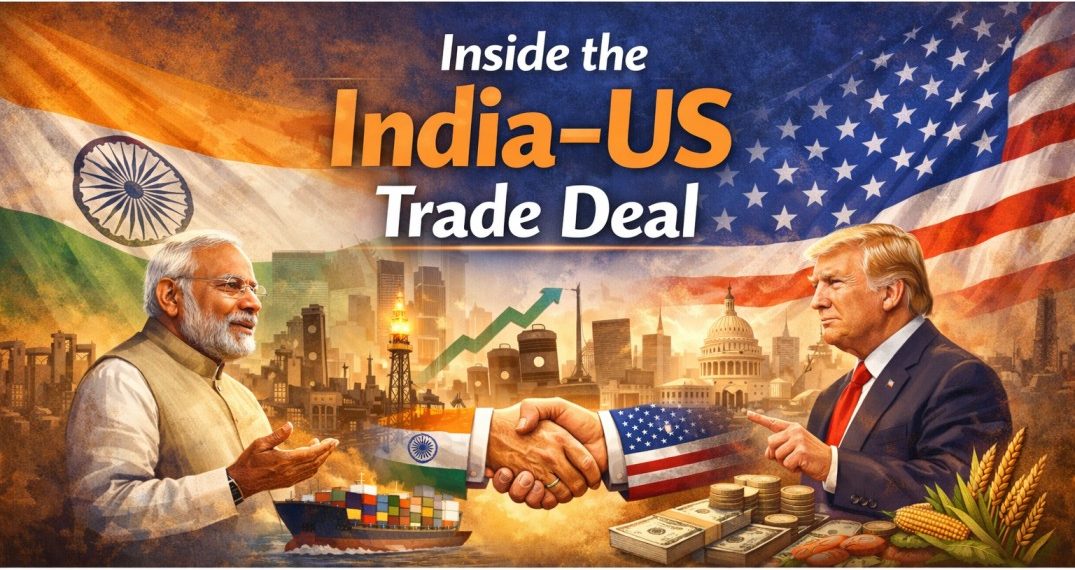
As global trade and geopolitics become increasingly intertwined, the India–US trade deal marks a pivotal moment in relations between the two countries. What has been presented as a routine tariff adjustment is, in reality, a carefully balanced exchange involving market access, energy choices, and strategic priorities. With a combined GDP of nearly $33 trillion, even modest trade shifts between India and the US carry outsized global implications.
This announcement also reflects a broader change in how trade agreements are shaped today. They are no longer just about numbers and tariffs. They are about leverage, positioning, and influence in a rapidly fragmenting global order.
The deal was announced by US President Donald Trump, who said it was finalised during a telephone conversation with Prime Minister Narendra Modi. The timing is notable. It comes at the end of the first year of Trump’s renewed global trade war—a period during which India emerged as one of the most affected economies. Escalating tariffs and policy uncertainty had pushed India–US trade ties to one of their lowest points in recent months.
Soon after, Commerce Minister Piyush Goyal confirmed that India and the US would sign an agreement “shortly,” adding that a joint statement would follow once the final details were locked in. However, he did not disclose specifics, leaving key elements of the deal open to interpretation.
That lack of clarity has become the defining feature of the announcement. Beyond Trump’s claims, New Delhi has not publicly confirmed several crucial assertions—particularly on energy imports and tariff elimination. As a result, what should have been a confidence-building moment has instead sparked debate and scrutiny at home.
What exactly have Trump and Modi said?
The uncertainty begins with the sharply different versions offered by the two leaders.
On Monday, Trump posted on his Truth Social platform that he had spoken with Modi—calling him “one of my greatest friends”—about trade, geopolitics, and ending Russia’s war in Ukraine. According to Trump, Modi agreed that India would stop buying Russian oil and instead source energy from the US and possibly Venezuela.
Trump also claimed that, at Modi’s request and out of “friendship and respect,” the US agreed to reduce tariffs on Indian goods from 25% to 18%. US officials were quoted as saying that the additional 25% penalty tariffs imposed last year—linked to India’s Russian oil purchases—would also be withdrawn. If true, this would bring total tariffs down from 50% to 18%.
In return, Trump said India would slash both tariffs and non-tariff barriers on US goods to zero. He further claimed that India committed to purchasing over $500 billion worth of US energy, technology, agricultural products, coal, and other goods.
Modi’s response, posted shortly after on X, struck a noticeably different tone. He made no reference to a trade deal, did not mention Russian oil, and offered no commitment on large-scale US purchases.
Instead, he confirmed only that Made in India products would face a reduced tariff of 18% and thanked Trump for the announcement. He also praised Trump’s leadership, framing it as important for global peace and stability.
The contrast is striking. Analysts note that without a signed agreement or joint statement, the announcement appears more declaratory than definitive—raising more questions than it answers.
How strong are India–US trade ties today?
To understand why the claims matter, it helps to look at the numbers.
The US and China have long been India’s two largest trading partners. In 2024, the US overtook China to become India’s top partner, with bilateral trade of $129.2 billion, narrowly ahead of India–China trade at $127.7 billion.
Unlike its trade relationship with China—where India runs a large deficit of nearly $95 billion—India’s balance with the US is more favourable.
- US exports to India totalled around $41 billion, led by oils and fuels, precious stones, nuclear reactor parts, electrical machinery, and medical instruments.
- Indian exports to the US stood at nearly $87 billion, driven by pharmaceuticals, electrical machinery, and precious stones.
Against this backdrop, Trump’s claim that India agreed to buy over $500 billion worth of US goods has raised eyebrows. Such a commitment would require India to increase its purchases from the US by more than 1,150%.
For context, India’s total government spending in the latest Union Budget was about $590 billion. The claimed purchase commitment alone would equal nearly 85% of annual public expenditure.
Economists say this scale of buying is not just ambitious—it is economically implausible.
Why is the deal facing criticism in India?
Much of the domestic criticism stems from the apparent imbalance in how the deal has been described.
If Trump’s version is taken at face value, the US would continue to impose an 18% tariff on Indian goods, while India would offer duty-free access to US products. Trade experts argue that such an arrangement weakens India’s negotiating position and could hurt domestic industries over time.
The absence of sector-wise details has only added to the scepticism. Without clarity on which industries are protected and which are exposed, it is difficult to assess the long-term economic cost.
In short, critics are not opposing engagement with the US—but questioning the terms and transparency of that engagement.
Is agriculture the real flashpoint?
Agriculture has long been the most sensitive issue in India–US trade talks, and it remains a potential deal-breaker.
The US has consistently pushed for greater access to India’s agricultural market, including for genetically modified crops. For New Delhi, this is politically fraught territory. Nearly half of India’s population depends on agriculture for its livelihood, making the sector deeply protected.
Recent history offers a cautionary tale. Farmer protests against proposed farm reforms forced the government to repeal controversial laws, underscoring the political risks of rapid liberalisation.
While Indian officials have repeatedly said that farmers’ interests will not be compromised, recent comments from US officials suggest that American agricultural exports to India could rise under the deal. So far, New Delhi has remained silent on this point.
Economists warn that opening the agriculture sector could trigger widespread backlash. Allowing large US agribusinesses into India’s market could severely impact small and marginal farmers—making agriculture the most contentious and politically sensitive element of the proposed agreement.
Is India actually better off under the new tariff regime?
At first glance, India appears relatively better placed.
An 18% US tariff on Indian goods is lower than the rates imposed on several regional peers, including Pakistan at 19%, Bangladesh and Vietnam at 20%, and China at 34%.
However, this advantage is more fragile than it seems.
Many of India’s neighbours continue to benefit from the US Generalized System of Preferences (GSP), which allows duty-free access for select goods from developing economies. India was once the largest beneficiary of this programme but was removed in 2019 after trade tensions rose and India resisted opening certain domestic markets.
Without GSP benefits, a lower headline tariff may not translate into a meaningful competitive edge for Indian exporters.
What do we still not know about the ‘deal’?
The biggest unanswered question is whether a formal India–US Free Trade Agreement has actually been negotiated and concluded.
So far, no signed document, detailed framework, or timeline has been made public.
This stands in sharp contrast to India’s recently announced trade agreement with the European Union, which—despite still awaiting legal scrutiny—has clearly defined contours covering market access, non-tariff barriers, and investment protections.
Several other grey areas remain:
- Intellectual property rules, which could affect drug prices and access to medicines.
- Environmental and labour standards, which may be tied to market access.
- Digital taxation, particularly whether US technology giants would be exempt from India’s planned digital services tax.
Without transparency on these issues, critics argue that it is impossible to assess the true economic and social impact of the agreement.
How has India reacted at home?
Domestically, the response has been divided.
Prime Minister Modi met members of parliament on Tuesday morning and was reportedly congratulated on the announcement. Senior government leaders described the development as historic.
Home Minister Amit Shah said the deal would open new opportunities, boost employment, and accelerate India’s journey toward becoming a developed nation by 2047. Commerce Minister Piyush Goyal echoed this optimism, stating that sensitive sectors such as agriculture and dairy would be protected while labour-intensive, export-oriented industries would benefit.
However, no specific safeguards or enforcement mechanisms were outlined.
The opposition was far more sceptical. Leaders questioned the lack of transparency and demanded that the government release full details before celebrating the deal’s benefits. Without clarity, they argue, claims of economic gains remain unproven.
Does this signal a reset in India–US relations?
Public messaging from both leaders suggests an attempt to ease tensions that had built up over the past year.
Relations had been strained over immigration policies, higher H-1B visa fees, India’s continued purchase of Russian oil, and stalled trade negotiations. There were also diplomatic frictions after Trump claimed to have mediated regional conflicts—assertions New Delhi had firmly rejected.
Analysts say the announcement allows both leaders to project strength at home. For Trump, it reinforces the image of delivering wins through tough trade tactics. For Modi, it offers a way to show engagement with Washington without appearing to concede ground.
That said, rebuilding trust will take time. Core disagreements—especially around energy ties with Russia—are unlikely to vanish overnight. Still, the announcement may provide just enough political space for both sides to stabilise relations and keep negotiations moving.
For now, the India–US trade deal remains less a finished agreement and more a work in progress—one whose true contours will only become clear once the fine print is finally made public.
Tradz by EquityPandit leverages advanced AI technology to provide you with powerful market predictions and actionable stock scans. Download the app today and 10x your trading & investing journey!