 Live
Live
The Indian stock market in 2026 is not the same as it was five years ago. Today, there are more than 21 crore active demat accounts and the F&O volume is at an all-time high. In such a scenario, it’s not only about having a trading account but having a trading account that can cater to the requirements of traders in the present market conditions. In this blog, we will take a look at some of the key features required by traders in a trading account in 2026.
The Indian market has changed; has the trading setup changed?
India’s equity derivatives market is now the world’s largest in terms of contract volume. Thousands of crores of notional turnover are transacted alone in one trading session. The retail trader who is using a trading account with a standard five-level market depth and limited order types is using tools that were built for a different time in markets. In recent years, the digital revolution has revolutionised the trading scene in India. The difference between a well-executed trade and a missed one often lies in the tools and the trading platform traders use to analyse and execute trades.
In 2026, a trading account is not just a compliance gateway for traders to place a buy or sell order. It’s the infrastructure that traders use to manage their positions, access real-time data, plan strategies, and make informed trading decisions. Hence, the quality of that infrastructure is more important than most traders consider when selecting a trading platform.
What does a free demat account actually offer in 2026?
The democratisation of the demat account access is one of the most important changes in the Indian brokerage industry in recent years. There is no paperwork, no entry barriers, and no physical visit required to open a free demat account today. It is a 100% digital, Aadhaar-based process that is often activated within a few minutes.
However, the term “free” only applies to account opening; after that, it’s a different story across platforms. Some platforms offer a free demat account with basic investing features. While others, like Dhan provide a more advanced trading environment for active traders, with the same free account also offering access to advanced trading tools like options strategy builders, multi-leg order execution, real-time screeners, F&O analytics, and API access, etc.
Thus, the first step in determining if a trading setup is keeping up with today’s times is understanding what an individual’s existing account and platform offer beyond the free demat account, and whether it fulfills their needs. If it does, the trader can continue using that trading account, and if not, they can upgrade to a trading account that offers the advanced tools and features required by them.
The rise of the options trader in India
A structural shift has occurred in Indian retail participation over the last few years. Many of the active trading community have switched to options trading. This is because of the defined risk on the buy side, flexibility of strategy on the sell side, and the ability to take advantage of short-term fluctuations without significant capital investment.
But advanced features are needed for options trading, such as selecting a strike, understanding what the Greeks mean for risk at expiry, and how the pay-off of a multi-leg trade changes as the spot price moves, which a basic trading interface can’t offer.
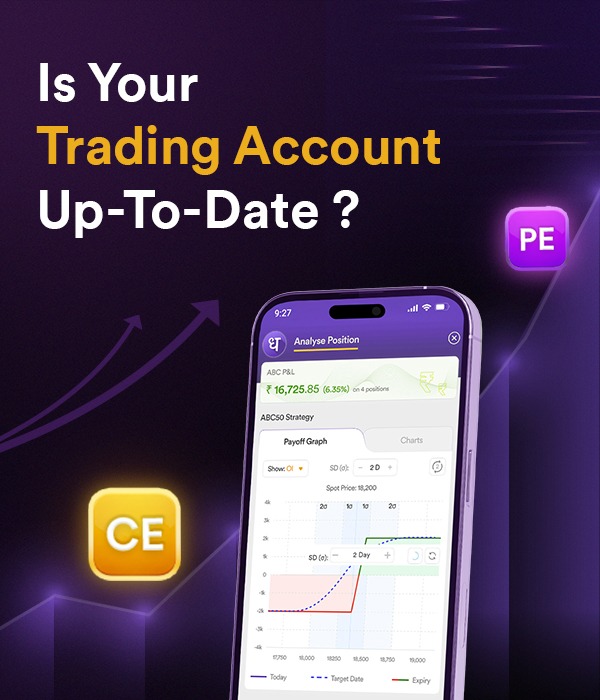
An options trading platform in 2026 should provide a range of features, including a comprehensive option chain that includes real-time updates on option Greeks (Delta, Gamma, Theta, Vega), the ability to structure multi-leg options trades, and a payoff diagram to visualise the trade before execution.
It should also have a real-time screener with multiple filters for high OI change, unusual volume, or specific volatility situations. Additionally, it should allow traders to place basket orders and make changes to open orders without having to switch between multiple screens.
If the trader with a trading account that only offers basic features decides to trade between two strike prices based on price only (no Greeks, no OI context, no payoff visualisation), then they are trading in partial darkness. Nowadays, there are several advanced tools and features that can assist traders in their trading journey. The question is whether their trading account offers them these advanced features or not.
The detail most traders overlook
Having a trading account with advanced analysis tools but slow order execution is only half the solution. During active trading, the gap between the price at which a trader places an order and the price at which the order executes (slippage) can make the difference between a winning and losing trade.
In 2026, Dhan has its own trading infrastructure to execute most orders within 25 milliseconds. For those using older, vendor-managed systems, it can take three to five times longer per order, which is not reflected on paper but is felt during a news event or expiry day volatility.
This is most important for intraday traders, F&O traders who adjust their positions near expiry, and those who use limit orders in volatile stocks where a few seconds of latency can make a meaningful difference. Thus, it is worth checking if an individual’s broker and trading account are updated over time.
Multiple segments, one account
The modern Indian trader is not restricted to one segment. The same person can buy a positional equity delivery trade, hedge it with index futures, buy a commodity option on gold, and apply for an upcoming IPO, all in the same week.
Therefore, a modern trading account should support all of this from a single trading account. This encompasses equity, F&O, commodity derivatives, mutual funds, and IPO with a unified view of margin, positions, and P&L across all segments in one dashboard.
The integration is important because capital efficiency across different segments is dependent on a consolidated margin view. For example, it allows equity holdings to be pledged to meet margin requirements for the F&O positions without moving money between accounts, the market participant capital works harder, and their idle holdings do not sit unused while they run derivative strategies.
API access and algorithmic trading
Systematic trading, which involves rules for entry, exit, position sizing, and risk management, has moved from being an institutional-only strategy to a growing part of retail participation in India. For traders who want to develop their own screeners, backtest systems, or automated execution logic, they require a trading account that provides API access without complex application procedures.
In 2026, free API access is a meaningful differentiator for retail traders who have transitioned to automated trading. The ability to build custom execution scripts without a monthly API fee reduces the cost of systematic trading and opens up strategies that simply are not possible on platforms offering basic features.
Is your current trading account keeping up?
Here’s a quick checklist to check whether the trading account is keeping up with market demand in 2026. It includes:
- Zero AMC and zero equity delivery brokerage: If you are paying an annual fee or platform fee, you are overpaying.
- Live option chain with Greeks: The trading platform should show delta, gamma, theta, and vega with real -time updates, not on a delay.
- Strategy builder with payoff visualisation: To enable you to build multi-leg strategies and visualise the maximum profit, maximum loss, and breakevens before you place the order.
- Integrated TradingView charts or similar: The trading platform should allow placing orders directly from charts while offering multiple indicators on charts at no additional charge.
- Quick, dependable performance on peak days: On days that have high market volatility, like the budget day, the account should offer low-latency order execution.
- API access: In case you run or intend to operate algorithmic strategies, free API access is a key differentiator.
- Multi-segment coverage: It should offer equity, F&O, and commodities instruments all in one account without switching platforms.
- SLBM involvement: if you hold stocks long-term, your platform should allow you to lend those holdings and earn passive rental income.
The bottom line
The question is not whether traders should have a trading account or not; it is a thing of the past, as traders can’t even execute a single trade in the Indian stock market without a trading account in 2026. With the digitalisation and online brokerage platform, demat account opening has become paperless and online, offering account opening at zero charges, and the account is activated within a few minutes.
The true test is whether the platform behind that account is built to meet the needs of today’s markets by offering traders some advanced features like real-time depth, options analytics, speed, multi-segment coverage, and the infrastructure to support their trading decisions.
Hence, the choice of the trading account is not an administrative one, but a strategic one that will impact each and every trade a trader makes from the day they begin their journey in the Indian stock market.