 Live
Live
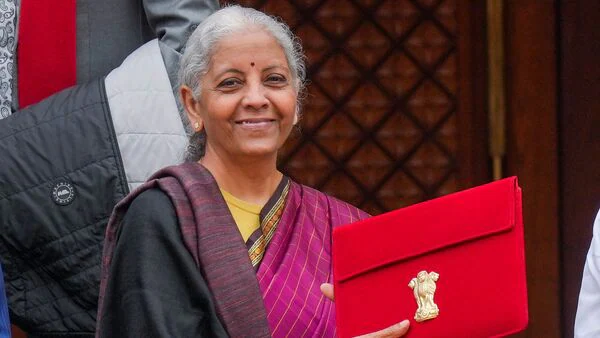
Finance Minister Nirmala Sitharaman will table the Union Budget for the 2026–27 financial year in the Lok Sabha during the ongoing Budget Session of Parliament.
As she gets ready to present her ninth straight Union Budget, Sitharaman’s journey since 2019 highlights major milestones that reflect India’s evolving economic priorities.
In 2019, she created history by becoming India’s first full-time woman Finance Minister. She also broke away from colonial-era traditions by replacing the briefcase with a red bahi-khata.
In 2020, she delivered the longest Budget speech ever, rolled out a new optional income tax regime, and announced the National Infrastructure Pipeline.
During the pandemic-hit year of 2021, she presented a Budget that strongly focused on healthcare and infrastructure, structured around six key pillars aimed at economic recovery and growth.
In 2022, she outlined a long-term vision for Amrit Kaal and backed it with a sharp increase in capital expenditure to push infrastructure-led development.
The 2023 Budget introduced the government’s Saptarishi priorities, with emphasis on inclusive growth, green development, and sustaining investment momentum.
In 2024, she first presented an Interim Budget ahead of elections and later followed it with a full Budget, maintaining a strong focus on welfare measures and infrastructure spending.
Her 2025 Budget placed the spotlight on four core groups—the poor, youth, farmers, and women—while advancing structural reforms.
Now in 2026, Sitharaman stands poised to set a new benchmark, with nine consecutive Budgets highlighting policy continuity and sustained reform momentum.
As she presents the Union Budget 2026 today, income tax proposals and slab revisions will remain in sharp focus. While expectations point to limited changes in income tax slabs, taxpayers continue to hope for greater relief and meaningful tweaks under the new tax regime.
Union Budget 2026: Kartavya of Budget.
Finance Minister Nirmala Sitharaman said Budget 2026 is guided by three core ‘Kartavya’, outlining the government’s roadmap to accelerate growth while ensuring inclusive development.
- The first ‘Kartavya’ focuses on accelerating and sustaining economic growth by enhancing competitiveness. It also aims to build resilience against volatile global dynamics.
- The second aims to fulfil people’s aspirations by strengthening their capabilities. Furthermore, it positions them as key partners in India’s journey towards prosperity.
- The third ‘Kartavya’, she said, is anchored in the principles of sab ka saath, sab ka vikas.
This ensures that every family, community, and region has access to resources, amenities, and opportunities for meaningful participation.
Union Budget 2026: Intervention in six areas.
- Scaling up manufacturing in seven strategic and frontier sectors
- Rejuvenating legacy industrial sectors
- Creating champion MSMEs
- Delivering a powerful push for infrastructure
- Ensuring long-term security and stability
- Developing city economic regions
Union Budget 2026: Proposes Rs 10,000 crore Biopharma Initiative
Finance Minister Nirmala Sitharaman has proposed the Biopharma Shakti initiative with an outlay of Rs 10,000 crore over the next five years to position India as a global biopharma manufacturing hub.
Union Budget 2026: SME Growth Fund to Develop Textile Skilling System
Finance Minister Nirmala Sitharaman has so far announced a series of key initiatives aimed at boosting growth across multiple sectors. These include a Rs 10,000 crore fund to support the expansion of small and medium enterprises, the proposal of a National Fibre Scheme, and a new plan to strengthen and modernise the textile skilling ecosystem. She also unveiled the development of three rare earth corridors to enhance strategic capabilities, along with a Rs 2,000 crore fund to provide targeted support to micro enterprises.
Union Budget 2026: Mahatma Gandhi Gram Swaraj Initiative
Finance Minister Nirmala Sitharaman announced the Mahatma Gandhi Gram Swaraj Initiative to strengthen the khadi, handloom and handicraft sectors. She said the initiative will link these products to global markets, offer branding support, and streamline training, skill development and quality standards. The scheme aims to benefit weavers, village industries, the One District One Product (ODOP) programme and rural youth.
Union Budget 2026: 5 Regional Medical Hubs
The Finance Minister announced a new scheme to support states through the creation of five regional medical hubs in partnership with the private sector, aimed at generating diverse job opportunities for healthcare professionals. She also proposed setting up three new All India Institutes of Ayurveda, upgrading drug testing laboratories to higher standards, and training 1.5 lakh caregivers to strengthen the healthcare workforce. In addition, the government plans to develop medical tourism hubs integrated with AYUSH centres to promote traditional healthcare systems alongside modern medicine.
Union Budget 2026: Education Sector Announcements
- The government will support states in setting up five university townships near major industrial corridors.
- It will establish one girls’ hostel in every district to improve access to education for women.
- The plan includes setting up four advanced telescope facilities for astrophysics and astronomy research.
- The government will set up a new National Institute of Design (NID) in the North East.
- It will promote the development of multiple universities and research institutions across the country.
- The Centre will introduce loan-linked subsidy support for veterinary colleges.
- The government will launch a pilot scheme to train 10,000 tourist guides across 20 key tourism destinations.
Union Budget 2026: 7 High-Speed Rail Corridors
Finance Minister announces 7 high-speed rail corridors
- Mumbai-Pune
- Hyderabad-Banglore
- Pune-Hyderabad
- Hyderabad-Chennai
- Delhi-Varanasi
- Chennai-Banglore
- Varanasi-Siliguri
Union Budget 2026: Support for High Value Crops
Finance Minister Nirmala Sitharaman said the government will promote high-value crops such as coconut and cashew in coastal regions and work towards making India self-reliant in their production and trade. She also announced measures to boost the incomes of farmers engaged in cultivating walnuts, almonds and pine nuts. In addition, the Centre will support states in expanding and strengthening sandalwood cultivation across suitable regions.
Union Budget 2026: FY27 Fiscal Deficit seen at 4.3% of GDP
- FY27 Fiscal Deficit seen at 4.3% of GDP
- FY27 Net tax receipts seen at Rs 28.75 lakh cr
- Simplified Income tax rules will be notified shortly
Union Budget 2026: Capex Target Raised to Rs 12.2 Lakh Crore
Finance Minister Nirmala Sitharaman said the government will raise the capital expenditure target to Rs 12.2 lakh crore for FY27, up from Rs 11.2 lakh crore allocated in the current financial year. She announced several measures to strengthen infrastructure development, stating that the government will continue to focus on expanding infrastructure in Tier-2 and Tier-3 cities. Sitharaman also proposed setting up a risk guarantee fund for the infrastructure sector to encourage investment. In addition, the government will introduce a scheme to enhance construction and infrastructure equipment to boost domestic manufacturing. She further said the Centre will support professional bodies such as ICAI and ICSI in designing short-term, modular courses to build skilled manpower.
Union Budget 2026: Foreign Trips Relief
The Union Budget has brought relief for Indians planning to travel abroad. The Finance Minister announced a sharp cut in the Tax Collected at Source (TCS) on overseas tour packages, making international travel more affordable and reducing the tax burden at the time of booking. Under the new proposal, the government will levy a flat 2% TCS on foreign tour packages, compared with the earlier rates of 5% and 20%. The Budget has also removed the minimum threshold, ensuring travellers pay significantly lower upfront tax when booking international trips.
Union Budget 2026: Extension of ITR Deadline
The government has proposed extending the deadline to revise tax returns from December 31 to March 31, subject to a nominal fee. It has also recommended staggering return filing timelines across categories: individuals filing ITR-1 and ITR-2 can file until July 31, while non-audit businesses and trusts will get time until August 31.
Union Budget 2026: IT Sector Announcements
India already leads the world in software development, IT-enabled services, knowledge process outsourcing, and contract R&D, and the government has now brought all these activities under a single umbrella called Information Technology Services. It has introduced a uniform safe harbour margin of 15.5% for all IT services and raised the eligibility threshold from Rs 300 crore to Rs 2,000 crore. To further ease compliance, the government will process safe harbour approvals through an automated, rule-based system, eliminating manual scrutiny by tax officials.