 Live
Live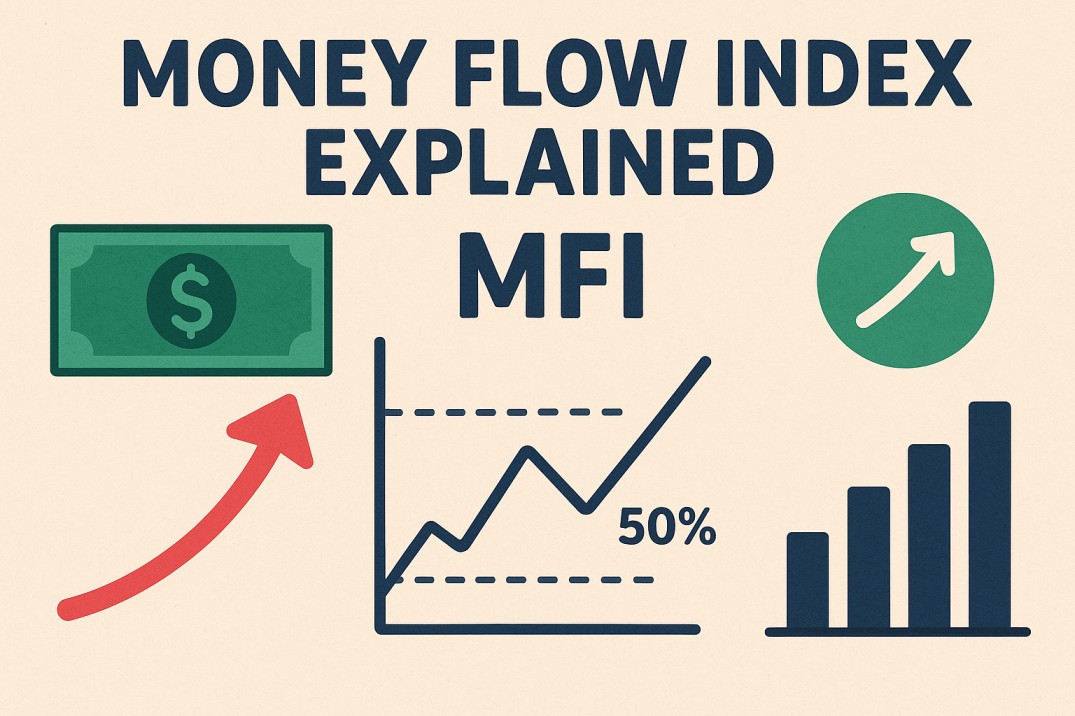
Ever wish you could read the market’s heartbeat — knowing exactly when money is rushing in or quietly slipping out of a stock? That’s the power of the Money Flow Index (MFI). More than just another price indicator, it blends price and volume to reveal the true flow of money.
If you want to catch shifts in market momentum before everyone else does, understanding the MFI might just be your next trading edge.
How the Money Flow Index (MFI) Works
The Money Flow Index (MFI) is a technical indicator that shows whether money is moving into or out of a stock. It gives a reading between 0 and 100 — where values above 80 suggest the stock is overbought and below 20 suggest it’s oversold.
Created in the early 1990s by Gene Quong and Avrum Soudack, MFI stands out because it combines price movement and trading volume. Unlike other indicators that only track price, the MFI reflects actual market participation — showing not just where the price is going, but how strongly investors are supporting that move.
Think of it this way: a stock rising with high volume indicates real buying strength. But if the price climbs on weak volume, it could be a temporary push — and MFI helps you tell the difference.
How to Calculate the Money Flow Index (MFI)
The MFI may sound complex, but its logic is quite straightforward. It’s built step by step using both price and volume data:
- Find the Typical Price (TP)
Add the day’s High, Low, and Close prices, then divide by 3.
TP = (High + Low + Close) / 3
- Calculate the Money Flow (MF)
Multiply the Typical Price by the Trading Volume.
MF = TP × Volume
- Classify Money Flow as Positive or Negative
- If today’s TP is higher than yesterday’s → Positive Money Flow
- If today’s TP is lower → Negative Money Flow
- Sum the Flows Over 14 Days
Add up all positive and negative money flows separately over a 14-day period (the most common timeframe).
- Find the Money Ratio (MR)
MR = Positive MF / Negative MF
- Calculate the MFI
MFI = 100 – [100 / (1 + MR)]
(Or, equivalently: MFI = (100 × Positive MF) / (Positive MF + Negative MF))
Interpreting the MFI:
- MFI > 80: The stock may be overbought (too much buying pressure).
- MFI < 20: The stock may be oversold (too much selling pressure).
Example:
If a stock’s MFI crosses above 80 after a long rally, traders might anticipate a short-term correction. On the other hand, if it dips below 20 after a sharp fall, it could hint at an upcoming rebound.
Trading with the Money Flow Index (MFI)
Once you understand how MFI works, using it in real trades becomes much easier. It helps traders gauge market sentiment, momentum, and potential reversal points. Let’s see how.
1. Spot Overbought Zones (MFI above 80)
When MFI rises above 80, it signals intense buying pressure. The stock may have run up too fast and could face selling soon. Traders often wait for MFI to drop back below 80 before booking profits or shorting positions.
2. Spot Oversold Zones (MFI below 20)
An MFI below 20 indicates heavy selling pressure. The stock might be undervalued in the short term, giving room for a rebound. Traders often enter when MFI climbs back above 20, confirming renewed buying interest.
3. Watch for Divergences
This is where MFI truly shines.
- Bearish Divergence: The stock makes a new high, but MFI doesn’t. This shows buying pressure is weakening — a potential sell signal.
- Bullish Divergence: The stock hits new lows, but MFI starts rising — suggesting buyers are quietly returning.
Example: Suppose a stock hits a new price high, but the MFI starts to flatten or fall. That’s your cue that buyers might be running out of steam.
4. Use the 50-Level as a Midpoint
Think of 50 as the market’s balance point.
- MFI above 50 → Buyers are in control.
- MFI below 50 → Sellers dominate.
This midpoint helps assess overall market strength or weakness even before extreme levels are reached.
5. Combine MFI with Other Indicators
The best traders rarely rely on a single tool. Use MFI with Moving Averages, RSI (Relative Strength Index), or MACD for confirmation.
For instance, if MFI rises from an oversold zone while the price stays above its 50-day moving average, that’s a stronger buy signal than either indicator alone.
6. Best for Short- to Medium-Term Trades
The MFI works particularly well for swing trading or positional trading. It captures the flow of money over several days, making it more reliable for short- to medium-term analysis rather than quick intraday scalps.
Benefits of Using the Money Flow Index (MFI)
Why do traders love this indicator? Because it packs a lot of insight into one number.
1. Identifies Overbought & Oversold Conditions
By showing when a stock is potentially overextended, the MFI helps you act before the market does.
- Above 80 → Overbought; may see a pullback.
- Below 20 → Oversold; may see a bounce.
This early warning system helps traders time entries and exits more precisely.
2. Highlights Divergence Signals
When MFI and price move in opposite directions, it signals a possible shift in trend.
- Bullish Divergence: MFI climbs while price falls — buyers may soon step in.
- Bearish Divergence: MFI falls while price rises — buying pressure may be fading.
3. Detects Failure Swings (Early Reversals)
Failure swings occur when the price and MFI disagree about the next move — often before the market catches on.
- Bullish Swing: Price makes a lower low, MFI makes a higher low → Buy signal.
- Bearish Swing: Price makes a higher high, MFI makes a lower high → Sell signal.
These patterns often signal turning points in market momentum.
Limitations of the Money Flow Index (MFI)
Like all indicators, MFI has its blind spots. It’s based on past data — usually 14 days — and can’t predict sudden events like earnings surprises, policy changes, or global news that shake markets overnight.
For example, even if MFI shows a bullish setup, a surprise interest rate hike could completely reverse the trend. That’s why professional traders always pair MFI with fundamental insights and other technical indicators for confirmation.
Bottomline
The Money Flow Index is like a financial stethoscope — letting you listen to the market’s heartbeat. By combining price and volume, it reveals whether money is truly entering or leaving a stock, often before the trend becomes obvious.
It helps you spot overbought and oversold levels, identify divergences, and catch early reversals, giving your trades a sharper edge.
But remember — MFI isn’t a crystal ball. The smartest move is to use it alongside other tools and market context to make well-rounded, confident trading decisions. When read correctly, the MFI doesn’t just show where the market is — it often hints at where it’s going next.
Ready to invest like a pro? Unicorn Signals app equips you with 100+ Free tools and knowledge you need to succeed. Download the Unicorn Signals app and gain access to daily stock lists and insightful market analysis and much more!