 Live
Live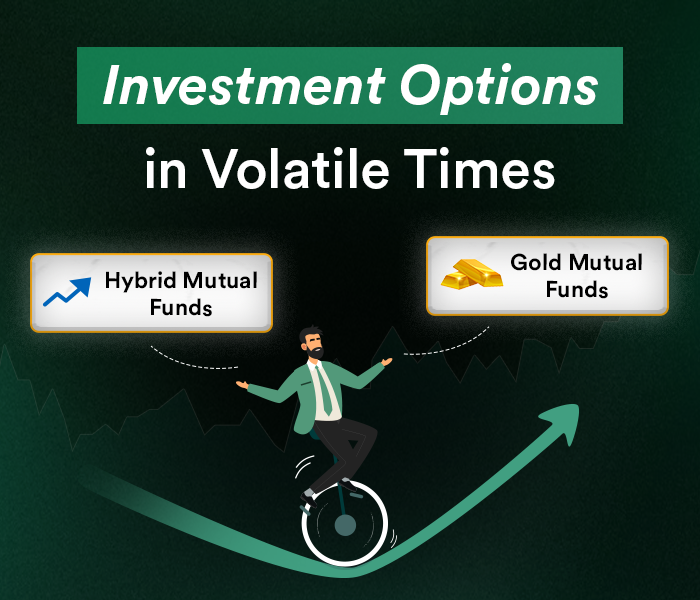
When markets turn volatile, investors often prioritize capital protection, easy access to funds, and steady, low-risk returns. The year 2025 brings its own set of challenges, ranging from fluctuating interest rates and inflationary trends to geopolitical uncertainties and shifting trade policies.
In this environment, selecting the right avenues to park your money becomes essential. In this article, we’ll evaluate reliable investment options designed to offer stability during periods of volatility.
1. Hybrid Mutual Funds
When stock markets fluctuate sharply, investors often find themselves torn between protecting capital and chasing growth. Hybrid Mutual Funds offer a middle path, by combining equity and debt exposure within a single product, they deliver moderate returns with lower volatility compared to pure equity funds.
Hybrid mutual funds invest in a mix of asset classes, primarily equity (stocks) and debt instruments (bonds, government securities, money market instruments). Some categories also include gold or real estate investment trusts (REITs) for further diversification.
By dynamically balancing allocations between these asset classes, hybrid funds aim to capture upside potential during bull markets while providing downside protection during market corrections.
The year 2025 has witnessed a significant surge in investor interest towards hybrid funds, especially Balanced Advantage and Arbitrage Funds. According to AMFI data, hybrid category inflows for May 2025 stood at ₹20,765 crore, marking a 46% increase from April’s ₹14,247 crore. This rise highlights the growing preference among investors for funds that can navigate market volatility with built-in risk management mechanisms.
Key Benefits of Hybrid Mutual Funds
- Diversification Across Asset Classes: Hybrid funds invest in a mix of equity, debt, and sometimes other assets like gold or REITs, helping reduce concentration risk and providing a balanced return profile.
- Reduced Volatility: Compared to pure equity funds, hybrid funds typically experience lower portfolio swings, making them suitable for investors with moderate risk tolerance.
- Dynamic Asset Allocation: Categories like Balanced Advantage Funds automatically adjust the equity-debt mix based on market conditions, helping investors avoid the need for frequent portfolio rebalancing.
- SIP-Friendly: Investors can start with small amounts through Systematic Investment Plans (SIPs), making it easier to build wealth gradually while navigating market volatility.
2. Gold Mutual Funds
Gold has always held a special place in Indian investing culture, not just as a symbol of wealth, but as a financial shield during uncertain times. In 2025, with the Indian stock markets experiencing bouts of sharp corrections and global economic concerns persisting, gold has once again proven its value as a safe-haven asset.
According to the World Gold Council, gold prices in India surged by over 30% year-to-date by mid-2025, reaching around ₹93,000 per 10 grams by late April. Factors like geopolitical tensions, inflation worries, and weak equity market performance have further strengthened gold’s role in investor portfolios.
Today, investors no longer need to buy physical gold to benefit from its price appreciation. Financial products like Gold Exchange Traded Funds (Gold ETFs) and Gold Mutual Funds offer convenient, liquid, and storage-free ways to invest in gold.
Gold ETFs are investment funds that trade on stock exchanges just like shares and directly invest in physical gold. Each unit of a Gold ETF typically represents one gram of gold.
Gold Mutual Funds offer an alternative for those who don’t have a demat account or prefer traditional mutual fund routes. These funds invest primarily in Gold ETFs, giving investors indirect exposure to gold prices.
Key Benefits of Gold Mutual Funds
- No Making Charges or Wastage: Unlike jewellery purchases, there are no hidden costs like making charges.
- Regulated and Transparent: Both products are regulated by SEBI, ensuring investor protection.
- Ease of Tracking: Investors can monitor NAVs and market performance daily.
- Cost-Effective Entry Point: Even small investors can gain exposure to gold without buying large quantities.
- Portfolio Diversification: Both options act as effective tools for spreading risk during volatile equity or debt market phases.
3. Government Securities (G-Secs) and RBI Bonds
Backed by the Government of India’s sovereign assurance, G-Secs and RBI Savings Bonds are considered some of the most secure avenues for investors. These instruments are particularly appealing during volatile markets because they combine capital protection with predictable returns, an ideal combination for risk-averse investors.
G-Secs are debt instruments issued by the government to finance its fiscal needs. They are available in various tenures, ranging from short-term Treasury Bills (T-Bills) to long-term bonds.
By mid-2025, 10-year G-Secs were yielding between 6.3% to 6.8%, while RBI Savings Bonds offered a fixed interest rate of 8.05%, paid semi-annually.
Key Benefits of Government Securities
- Sovereign Guarantee: Backed by the Government of India.
- Predictable Income: Fixed coupon payouts on a semi-annual basis.
- Liquidity: Tradable on exchanges for those who need premature liquidity.
- Inflation-Linked Options: Some G-Secs are indexed to inflation for better real returns.
4. Fixed Deposits (FDs)
Fixed Deposits (FDs) continue to be one of the most trusted low-risk investment options for Indian investors, especially during times of market volatility. Their core appeal lies in simplicity and capital protection. With FDs, you deposit a lump sum for a predetermined tenure and earn a fixed rate of interest, completely shielded from market fluctuations.
As of June 2025, major Indian banks are offering FD interest rates ranging from 6.75% to 8.25% for tenures between 1 to 3 years. Senior citizens enjoy an additional 0.5% interest rate, making FDs particularly attractive for retirees and conservative savers.
Key Benefits of Fixed Deposits:
- Guaranteed Returns: The interest rate is locked in at the time of investment, ensuring stable and predictable earnings, irrespective of market ups and downs.
- Flexible Tenure Options: Investors can choose deposit durations ranging from a few months to as long as 10 years, depending on their financial goals.
- Reinvestment Opportunities: Many banks offer cumulative FDs where earned interest is reinvested, leading to compounded growth over time.
- Deposit Insurance: Under the DICGC scheme, deposits of up to ₹5 lakh per depositor per bank are covered, providing an extra safeguard for risk-averse individuals.
Though FDs provide fixed returns, they carry an inherent inflation risk. Rising prices can offset the gains, reducing the real worth of your deposit over time.
5. National Pension System (NPS)
For investors seeking a disciplined, long-term investment to secure their retirement, the National Pension System (NPS) offers a government-backed, low-cost, and flexible solution. Regulated by the Pension Fund Regulatory and Development Authority (PFRDA), NPS has grown steadily even in volatile markets, making it a popular choice for future-focused savers.
As of March 2025, NPS assets under management crossed ₹14.4 lakh crore, with a subscriber base exceeding 1.65 crore. This reflects rising interest among salaried employees, self-employed professionals, and now even parents investing for their children’s future.
The launch of NPS Vatsalya, a minor-focused variant of the National Pension System, on September 18, 2024, has already made headway among young investors. According to the PFRDA chairperson, over 100,000 children have enrolled under the scheme, enabling parents to start building a retirement corpus for their children from an early age.
Key Benefits of NPS
- Tax Deductions: Contributions are eligible for tax deductions up to ₹50,000 under Sections 80CCD(1B), which is beyond the ₹1.5 lakh under Section 80C.
- Low Cost: One of the lowest-cost retirement products in India.
- Customizable Asset Allocation: Choose between aggressive, moderate, and conservative investment plans.
- Partial Withdrawals: Allowed for specific needs like education, marriage, or medical emergencies.
- At Retirement: Up to 60% of the corpus can be withdrawn tax-free, while the balance is used to purchase an annuity for regular post-retirement income.
Key Considerations for Parking Money in Volatile Markets
Here is what you need to consider before investing during volatile markets.
1. Define Your Time Horizon
Align your investment choice with your financial timeline. For short-term needs, consider highly liquid options like liquid funds, Treasury Bills (T-Bills), or Fixed Deposits with matching tenures. For medium to long-term objectives, explore instruments that offer stability with moderate returns, such as hybrid funds or NPS.
2. Evaluate Liquidity Requirements
If you anticipate the need to access your funds on short notice, prioritize avenues offering high liquidity. Options such as money market funds, liquid FDs, or even Gold ETFs allow relatively quick exits without significant penalties.
3. Factor in Taxation
Tax treatment varies across instruments and can significantly impact your net returns. For instance, interest from Fixed Deposits is fully taxable, while gains from equity-based hybrid funds benefit from a lower tax rate if held long term. Always evaluate post-tax returns before making a decision.
4. Monitor Inflation Impact
Ensure your chosen instruments have the potential to at least match or outpace inflation. Gold and certain hybrid funds have historically provided a hedge against inflation over the medium to long term.
5. Review Regularly
Markets, interest rates, and scheme features evolve over time. Review your portfolio periodically, ideally once a year, to confirm that your investments continue to align with your liquidity needs and risk appetite.
Conclusion
In volatile markets, the priority is not just about earning returns but safeguarding your capital and maintaining liquidity. Instruments like Hybrid funds, Gold funds, Government Securities, FDs, and NPS each offer unique advantages depending on your financial goals and risk appetite.
By diversifying across these avenues and aligning them with your time horizon, you can create a resilient parking strategy that protects your wealth while keeping you prepared for future opportunities.